Learn » Blog » A clean-break standard for the FMA chair
A clean-break standard for the FMA chair
Published on 12/08/2026

Why a Chair-specific approach to concurrent issuer governance roles is worth considering
Advocacy paper | 12 August 2026 | Sam Stubbs, Simplicity
Recommendation
The Government should consider adopting a clear institutional standard for the Chair of the Financial Markets Authority: as a matter of good governance, the Chair would ordinarily not simultaneously serve as a director or equivalent fiduciary of a New Zealand listed issuer, quoted-debt issuer, or other commercial entity materially within the issuer or market-conduct regulatory perimeter.
James Miller currently serves as Chair or director of Channel Infrastructure NZ, Fletcher Building Limited, Fletcher Building Industries Limited, Ryman Healthcare Limited and Vista Group International Limited. Consistent with a Chair-specific approach, the Government and Miller should consider an orderly transition from those issuer roles.
In the interim, the FMA should ensure appropriate arrangements are in place to identify and manage actual, potential and perceived conflicts, with reasonable public transparency about the principles governing those arrangements.
This is an institutional governance issue, not an allegation of personal misconduct or lack of integrity by James Miller.
Executive position
James Miller commenced a five-year term as Chair of the Financial Markets Authority on 6 August 2026. He brings substantial capital-markets and governance experience, including prior service on the inaugural FMA Board. That experience is an important qualification for the role. [1] [71] [72] [79]
The question is not whether people with market experience should serve the FMA. They should. Nor is the proposition that every outside interest creates a statutory conflict. New Zealand is a small market, and the Crown Entities Act and FMA governance arrangements contemplate that board members may have industry connections requiring disclosure and management. [6] [7]
1. The case for a higher Chair-specific standard
Financial markets regulation depends on confidence as well as legal authority. The FMA must be, and must be seen to be, capable of regulating issuers and licensed market participants impartially.
This does not require every FMA member to sever all connections with the market. Industry expertise is one of the reasons experienced practitioners are appointed.
But the Chair performs a different function. The Chair influences Board agendas, strategic priorities, organisational culture and the relationship between the Board and management. The Chair is also the most prominent governance representative of the regulator. [18]
The independent Stobo investigation provides useful context. It illustrates that conflicts which may be manageable within the normal rhythm of a multi-member board can become more consequential at Chair level because of the Chair's sustained involvement in governance, strategy and regulatory activity. [14]
A reasonable governance standard would therefore not require the Chair to have no interests or market experience. Rather, it would seek to avoid recurring external fiduciary roles that create material intersections with core areas of the FMA's mandate.
2. Miller's issuer roles create recurring governance intersections
Miller's roles are not merely historical relationships with the market. The following current roles illustrate the breadth of the overlap. [2]-[5] [9]-[12] [77] [78]
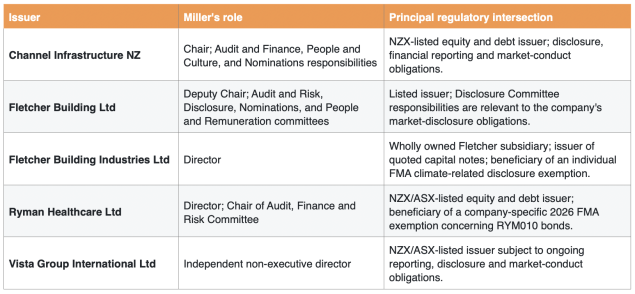
Table 1. Current issuer roles and principal regulatory intersections. Source numbering follows the underlying evidence paper.
Two examples illustrate the overlap. Fletcher Building Industries currently benefits from an FMA climate-related disclosure exemption. Ryman Healthcare received an FMA exemption in 2026 relating to its RYM010 bonds. [11] [12]
For any FMA matter specifically concerning a company of which Miller is a director, his interest must be assessed under the Crown Entities Act and applicable FMA conflicts arrangements and, where the statutory test is met, he may not participate. [6] [7]
Sector-wide regulation presents a somewhat different issue. An industry-wide policy does not automatically create the same statutory financial interest. But decisions about disclosure, financial reporting, exemptions and enforcement policy may nevertheless affect companies to which the Chair owes directors' duties. That can create an ongoing governance and perception issue even where the formal statutory non-participation rule is not triggered. [7] [8]
3. The limitations of relying on recusal at Chair level
Recusal is an important mechanism for discrete conflicts. It may be less satisfactory as a recurring feature of the governance arrangements surrounding the regulator's Chair.
The concern is cumulative rather than any single instance of recusal.
Repeated information barriers may limit the Chair's access to material relevant to regulatory work. Repeated withdrawal may shift leadership of particular matters to other directors. The need continually to determine what the Chair may see, discuss or influence can also add complexity to the governance of the regulator.
None of this implies improper conduct by Miller. The point is the opposite: good institutional design should minimise the number of occasions on which personal integrity and conflict-management processes have to carry that burden.
A cleaner institutional approach is therefore to reduce, where reasonably practicable, the need for recurring conflict management at source.
4. A potential stewardship consideration
There is also a potential governance consideration for institutional investors.
KiwiSaver and managed-investment providers may hold securities in companies on whose boards Miller serves. In exercising their stewardship responsibilities, those managers may from time to time take positions critical of an issuer's governance, remuneration, disclosure, capital allocation or performance.
Those managers may also be licensed or supervised by the FMA.
There is no suggestion that Miller would allow legitimate stewardship activity to affect a regulatory relationship, and none is alleged.
The narrower governance point is one of perception. Where an investment manager may be called upon to criticise a board on which the Chair of its regulator serves, an avoidable perception of tension can arise. A governance model that reduces the possibility of that perception may therefore support confidence in both stewardship and regulatory independence.
The point is not that such inhibition will occur, but that good institutional design can reduce the need for regulated managers to consider the issue at all.
5. New Zealand experience illustrates the issue
New Zealand practice does not establish a settled rule against external issuer directorships for the FMA Chair.
The publicly available record reviewed for this paper did not identify concurrent listed-company directorships for Simon Allen, Murray Jack or Mark Todd during their respective terms as Chair. That is an evidence-qualified observation rather than a claim of an established convention. [65]-[70]
Craig Stobo provides a counter-example: he remained Chair of NZX-listed NZ Windfarms for part of his FMA chairmanship. No allegation is made that this was unlawful or that it affected a particular FMA decision. [73]-[75]
The more useful lesson from the domestic experience is therefore not that New Zealand has previously applied a clean-break rule.
Rather, external governance roles can create issues requiring careful assessment and management at Chair level. The independent investigation into Stobo's subsequent Indi directorship found that he appropriately disclosed the interest and reasonably agreed to resign once a perceived conflict was raised, although his eventual resignation should have occurred sooner. [14]
That experience does not establish that all external directorships are inappropriate. It does support considering whether recurring conflicts are better avoided at source for the Chair rather than managed individually as they arise.
Miller's current roles span four listed issuer groups, including a directorship of Fletcher Building Industries Limited, a wholly owned Fletcher subsidiary and quoted-debt issuer. The present circumstances provide an opportunity to consider a clearer Chair-specific governance approach.
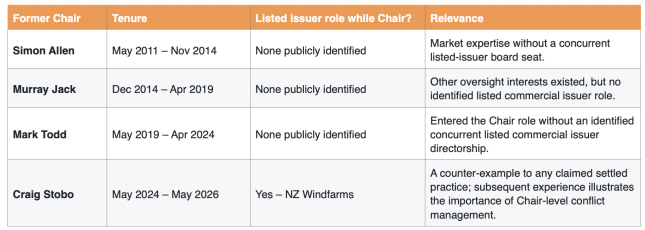
Table 2. Domestic precedent. “None publicly identified” is an evidence-qualified conclusion based on the contemporaneous public record reviewed.
6. International practice provides useful context
A review of publicly available information concerning the leadership of a range of comparable overseas financial-markets regulators did not identify a common practice of regulatory Chairs or equivalent leaders simultaneously serving on the boards of domestic listed commercial issuers.
International comparisons should be treated cautiously. Regulatory structures differ significantly between jurisdictions, public disclosures do not necessarily provide a complete record of outside interests, and some jurisdictions combine securities regulation with central banking or wider financial supervision.
The international material is therefore not advanced as establishing a universal rule or benchmark.
It provides context only. The case for a Chair-specific approach in New Zealand ultimately rests on the governance characteristics of the FMA, the Chair's role, and the desirability of minimising recurring conflicts and perceptions of conflict.
New Zealand does not need to sacrifice market expertise to pursue that objective. Experienced directors can continue to bring valuable expertise into public service while considering whether particular external roles should be relinquished where they create recurring governance tensions.
International context: The international material provides context only; it is not advanced as establishing a universal rule or complete comparative benchmark.
7. A practical way forward
The preferred governance outcome would be an orderly transition from Miller's current issuer directorships.
Miller's market and governance experience is an important qualification for the FMA role. A clean-break approach would retain the benefit of that experience while reducing recurring conflict assessments and recusals. The Government should therefore consider agreeing with Miller an orderly transition from his current issuer roles.
In the interim, the FMA should maintain appropriate arrangements for identifying and managing actual, potential or perceived conflicts.
Subject to legal and confidentiality obligations, reasonable public transparency about the principles governing those arrangements would also support confidence in the regulator, including:
- the approach to conflict assessment applying to the Chair;
- the principles governing participation and recusal; and
- how recurring issuer-related conflicts and any transition are managed.
No public statement identified in the appointment material reviewed as at the date of this paper explains those matters in detail.
Conclusion
This paper does not question James Miller's experience, judgement or integrity. His markets and governance experience is plainly relevant to his appointment.
Nor does it suggest that every outside interest held by an FMA Board member is inappropriate. The narrower question is whether a higher institutional standard is desirable for the Chair.
Miller's issuer directorships create recurring intersections between external fiduciary responsibilities and areas within the FMA's mandate. Those intersections may be manageable individually. But the Chair's distinctive role in governance, strategy and public standing makes repeated reliance on conflict-management arrangements less desirable than it may be for an ordinary Board member.
New Zealand experience illustrates the importance of careful Chair-level conflict management. International practice provides additional context, but no universal rule is suggested.
Against that background, there is a credible case for a prospective principle that the FMA Chair should ordinarily make a clean break from external fiduciary roles with listed or quoted issuers materially within the FMA's regulatory perimeter. Applied here, that would favour an orderly transition from Miller's current issuer roles, with appropriate interim conflict management and reasonable transparency.
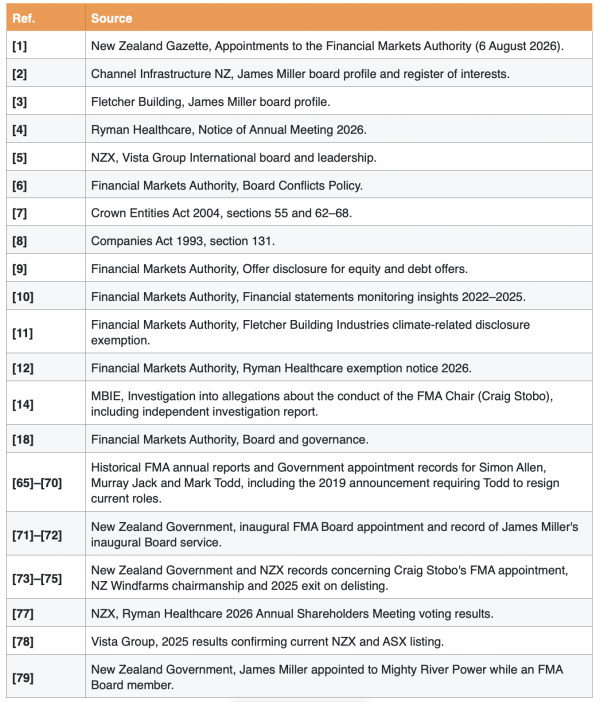
Selected source references
Numbering is retained from the underlying evidence paper so this redraft can be checked directly against the existing source pack.