Learn » Simplicity Research Hub » Why are regional rents becoming less affordable?
Why are regional rents becoming less affordable?
Published on 16/10/2026

Provincial rents used to be affordable. But rents have been rising in many provinces, while many urban places, including Auckland, have stalled or are falling.
Auckland, Wellington, and Christchurch renters now spend just over 35% income (average income is used throughout this piece) on rent, down from 39% in 2024, the lowest since 2013.
Many regional renters still pay over 40% of income on average, unchanged since 2022. The damage from the decade before was already done, and two flat years haven't undone it.
Why are city renters better off?
Average metro rents peaked at $625 a week at the end of 2024, have barely moved since, and have more recently dipped. High building consents post-COVID and policies enabling denser housing (such as those in Auckland) added much-needed stock to the city's housing markets, but the city story isn’t the complete story.
At the turn of the century, metro rents were 40% above provincial rents (areas like Nelson and Napier) and 63% above rural rents. By June 2026, those gaps have shrunk to 6% and 15%. To put that into perspective, ten years ago, Auckland rents were $132 a week higher than the Bay of Plenty. Today the gap is $4. Renters now pay near-city prices on regional incomes.
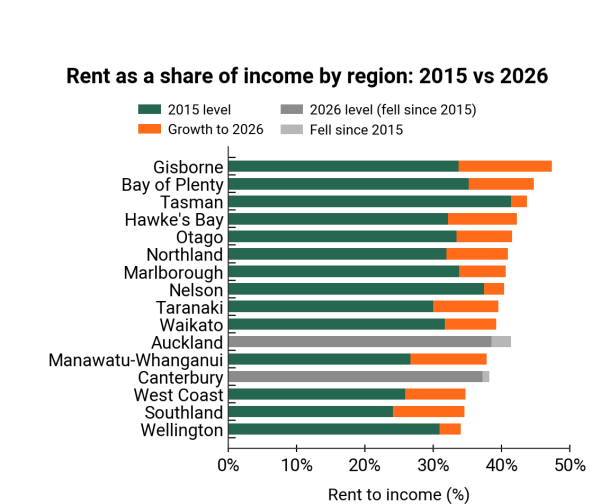
City jobs pay city wages and regional jobs generally pay regional wages. Affordability for renters has changed significantly since 2015, especially in the regions. Gisborne, which has the highest rent-to-income ratio in 2026, takes on average 47% of someone's income to rent, up from 34% in 2015. When regional rents reach near-city level, renters there spend more of their income to live there.
Rents are climbing fastest down south
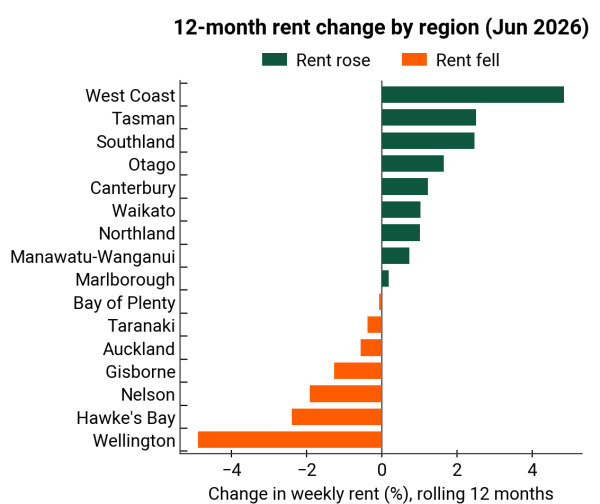
Most of the regions where rents have risen over the last year are in the South Island.
West Coast, Tasman, Southland, Otago and Canterbury have experienced the largest rent price increases in the country. West Coast rents are up about 5% to June 2026.
Why are West Coast rents rising so quickly?
Rent in Buller, Grey and Westland now averages over a third of people’s incomes; in Buller a decade ago, it took up around a fifth. It’s still just below the national average, but now higher than Wellington City.
There are a few reasons for this.
First, population growth. The West Coast grew by 4% (+1,400) between 2020-2025, double the rate it grew between 2015-2020. At the same time, we estimate around 650 new homes were added. That mix includes residential dwellings that have been sold, used as holiday homes, and rented out. But at the 2023 census, 20% of West Coast homes, around 3.7k, were unoccupied, either empty or with residents away. In other words, a chunk of additional stock isn’t reaching the rental market.
Second, demand for specific types of homes, in this case,one-bedroom places. Rents on one-beds have risen by over 120% since 2021, while one-bedroom rentals (measured through tenancy bonds) has roughly quadrupled to 160 over that same five-year stretch. Between the 2018 and 2023 censuses, the number of one-bedroom properties grew by 300. But since 2022, 90 more have become holiday homes.
What could make renting in the regions more affordable?
This isn’t an isolated issue on the West Coast. The discount people living in more rural areas would receive is disappearing. And because regional jobs simply don’t pay city wages, the squeeze hits harder. Places can no longer rely on being cheaper than cities to attract people in, so we need to rethink how wider policies can support these regions.
-
Make full use of income, housing and job support. Households should get all the income and housing support they’re entitled to. In addition, job support, training, and skills development can also help people find work that suits them and maximises their earnings.
-
Enable more targeted housing development. Build more homes in the regions, including rental stock for local workers. Regions should also target dwelling types that are in demand but short of supply, including smaller dwellings like one-bedroom units.
-
Support retained affordable housing supply. Require new developments to include a minimum share of affordable homes. The UK does this through inclusionary zoning. New Zealand should use it for regional housing.
-
Increase social housing supply. Public and rental housing lags owner-occupied stock, and lower-income renters feel it most. More social housing means the most vulnerable can be better looked after.