Learn » Simplicity Research Hub » Middle East escalations: what might it mean for financial markets?
Middle East escalations: what might it mean for financial markets?
Published on 02/03/2026
6 March 2026 – latest developments
Since this article was published earlier in the week, markets have started to react to the Middle East escalation, though the response so far has been more measured than some initially feared.
Oil and gas prices have moved higher as investors price in the risk of disruption to energy supply, particularly through the Strait of Hormuz. At the same time, some investors have shifted money into traditional “safe haven” assets such as the US dollar and gold. These reactions are typical when geopolitical uncertainty rises.
Equity markets, however, have so far taken the developments largely in their stride. Early trading suggested investors are currently pricing a scenario where tensions remain contained rather than escalating into a prolonged regional conflict. As always, the key factor for global markets will be how significantly energy supply is disrupted, and for how long.
There are also broader questions investors are grappling with. Some sectors, particularly oil and defence companies, may see short-term gains during periods of geopolitical tension. But these exposures typically make up only a small share of diversified global indices, and many investors continue to weigh financial returns against ethical considerations.
For investors, the core principles remain unchanged. Short-term volatility can feel unsettling, but reacting to daily balance movements or trying to time the market rarely leads to better outcomes. Focus on the things you can control: make sure your fund choice matches your risk appetite and time horizon, and continue contributing if you can.
---
The weekend strikes on Iran by the United States and Israel have added another layer of uncertainty to an already fragile global environment. While the stated objective was to neutralise security threats, the broader geopolitical implications are still unfolding.
At this stage, it is too early to know how events will develop. But when geopolitical tensions escalate, there are some fairly predictable economic channels that markets watch closely: oil prices, currencies, inflation, and global growth.
Here’s what we know so far, and what it could mean for New Zealand and KiwiSaver investors.
1. The global backdrop is becoming less predictable
The strikes occurred without United Nations Security Council authorisation and during ongoing Oman-mediated nuclear talks. That has raised questions about the strength of the post-WWII rules-based global system.
For countries like New Zealand, which have benefited from a relatively stable global trading and security framework, greater uncertainty increases complexity. Trade relationships, security alliances, and foreign policy decisions may require more balancing in a world that feels less coordinated, and less predictable.
This does not mean global cooperation disappears. But it does suggest that geopolitical risk is likely to remain a more regular feature of markets than it was in the decade before Covid.
2. Oil prices are the most immediate economic risk
When tensions rise in the Middle East, oil is usually the first pressure point.
Brent crude closed at around US$73 per barrel on Friday. Analysts expect a “war premium” when markets reopen (remember it's not yet Monday morning in the United States). If the Strait of Hormuz, through which around 20% of the world’s seaborne oil passes, were significantly disrupted, oil prices could move sharply higher, potentially above US$100 per barrel.
Iran’s Revolutionary Guard has warned vessels about transiting the Strait, and some shipping firms have already paused routes. The duration and scale of any disruption will matter far more than the initial headlines you might be seeing.
For New Zealand, higher oil prices would likely mean:
- Higher petrol prices. A sustained spike could push 91 unleaded above $3 per litre compared to around $2.50 currently.
- Increased costs for transport, construction, fertiliser, plastics, and agriculture.
- Broader inflation pressures if the shock persists.
See scenario table below showing the sensitivity to crude prices and exchange rates.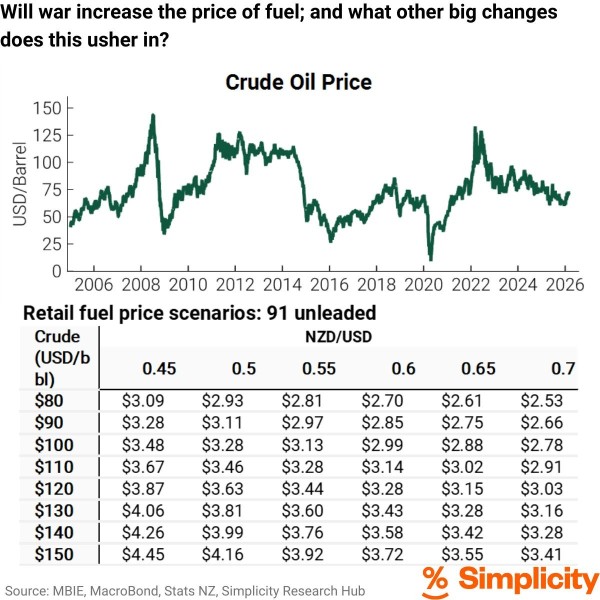
Fuel retailers typically hold around 7.5 days of inventory. So while price impacts are the most immediate risk, physical supply disruptions cannot be ruled out if tensions escalate.
3. What happens to the NZ dollar?
The New Zealand dollar tends to weaken when global risk rises. Investors often shift money into larger, perceived “safe haven” currencies during periods of stress.
A weaker NZD has mixed effects:
- Imports become more expensive, adding to inflation.
- Exporters benefit from higher NZD returns on overseas earnings.
- Provincial and agricultural sectors can receive a short-term boost.
If oil prices rise and the NZD falls at the same time, the impact at the pump and across imported goods could be amplified.
4. The broader risk: inflation and growth
If higher oil prices persist, the global economy could face a difficult mix of slower growth and rising inflation. Energy shocks have historically dampened global demand and increased production costs.
However, it is important to remember that not all geopolitical shocks become prolonged economic crises. The scale and duration of any impact will depend on how quickly tensions stabilise.
Markets tend to price in worst-case scenarios early, then adjust as more information becomes available.
--
What could this mean for markets and KiwiSaver?
When markets reopen, volatility is likely. Shares may fall sharply in the short term. Oil prices may rise. The NZD could weaken. That is the standard market reaction when geopolitical risk spikes. But history provides some perspective.
In recent years we have seen sharp market falls during:
- The Covid pandemic
- The Global Financial Crisis (GFC)
- 9/11
- The Gulf War
- Liberation Day (trade tariff escalations from the US)
In each case, markets fell quickly, then recovered over time. The path was uncomfortable, but the long-term trajectory of global growth did not permanently break. The investors who generally suffered the most were those who:
a) Switched to more conservative funds at the bottom
b) Locked in losses
c) Missed the recovery
KiwiSaver is a long-term investment. For most people, that means decades, not months.
So what should you do?
If you are worried, here are a few principles to keep in mind.
First, avoid reacting to daily balance movements. Markets can move sharply in both directions over short periods. Looking too often tends to increase the temptation to act emotionally.
Second, make sure your fund type matches your time horizon. If you are decades from retirement, higher growth funds are designed to return more over time, but require riding out higher volatility. If you are close to withdrawing funds (or are very risk averse), a more conservative fund may be appropriate. These decisions are best made calmly, not during a market sell-off or period of high volatility.
Third, keep contributing if you can. Regular contributions mean you buy more units when prices are lower. This is known as dollar-cost averaging, and it is one of the quiet advantages of long-term investing.
Finally, if you are unsure, talk to your provider. Big decisions are rarely best made late at night after scrolling through headlines.
The bigger picture
The global economy has always faced shocks: wars, recessions, pandemics, financial crises. Over time, economies adapt, companies innovate, and growth resumes. What may be changing is the frequency and unpredictability of geopolitical events. That makes diversification, discipline, and long-term thinking even more important.
Nothing about the long-term case for investing has fundamentally changed. But the path there may be bumpier than we would like. In uncertain times, the goal is not to predict every headline. It is to stay deliberate, diversified, and focused on the horizon that actually matters.