Learn » Simplicity Research Hub » Hunger games: Why nz’s future workforce is being left behind
Hunger games: Why nz’s future workforce is being left behind
Published on 22/07/2026

Originally published on The Post
By Nihal Sohanpal
My twenty-something friends are job hunting, and it’s hunger games out there.
Countless of them have left the country in the past few years. Some are doing the classic OE but more left because they couldn't get a job in their field of interest or study.
One friend did unpaid internships for months, applying for countless jobs, and then landed work in Australia within weeks of arriving. Do I wish these bright, passionate people had stayed and started their careers here? Absolutely. Do I blame them for leaving? Absolutely not.
The latest New Zealand jobs data for May looked encouraging: 16,000+ more jobs than at the same time last year; a nascent recovery which hasn’t yet been derailed by the war on Iran. This wasn’t spread evenly across the country. Canterbury has added 7,600 jobs since May last year, more than Auckland and Waikato combined. Otago, Southland, and Bay of Plenty are climbing too. Northland is shedding jobs: down 1,650, the worst in the country. Wellington and Hawke's Bay have fewer as well.
But the sharpest divide isn’t regional. What the headlines from that latest data release didn’t show is that the recession and recovery are being felt differently across generations, and the young have been hit the hardest. Currently, around 93,000 young Kiwis under 25 are not in employment, education, or training (NEET), 20,000 more than three years ago.
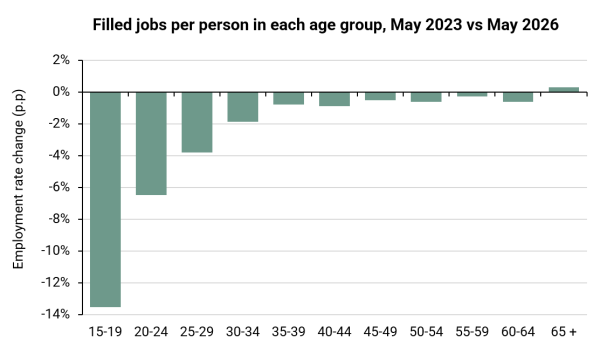
Since May 2023, employment rates as shown in the graph below (which measure the share of an age group's population that is in a filled job) have declined most notably for the younger groups: 15–19-year-olds are down nearly 14 percentage points, and 20–24-year-olds are down around 7 points. The fall keeps shrinking with age.
This is not surprising because in a weak economy, employers simply need fewer workers as we are spending less, and because those with more experience and qualifications are competing for fewer vacancies. For those young people, though, being out of work now can cause scarring, where the job loss or idleness hurts future career and life trajectories unless training, education, or other pathways are made available.
Source: Stats NZ, Simplicity Research Hub
The starting point in any discussion about these numbers should be to dismiss the myth that the young are a problem to manage. Young NEET Kiwis aren’t the issue. They’re victims of the recession. But they're a motivated, available workforce sitting idle while the economy starts to rebuild. Opportunities that keep them in the game now will give us workers ready when demand fully returns.
There is renewed policy focus on pathways beyond university, with trades training from National, and a refreshed Apprenticeship Boost scheme from Labour. Both are welcome, because not everyone is suited to university and the trades mean earning while learning, having smaller (if any) student loans, and they can open the door to entrepreneurship.
Some practical ideas of what could be done (but not limited to) include:
- Increase training and apprenticeships coverage: Apprenticeships Boost currently covers only some trades for only one year. Expanding both will encourage businesses to take on more trainees.
- Pilot a youth job guarantee scheme: As researcher Max Rashbrooke has previously suggested, a job placement - whether in the public, private or state-funded NGO sector - could be hugely beneficial, acting as a ‘circuit breaker’ for any young person at risk of long-term unemployment. Evaluations of similar schemes overseas have shown lifted employment outcomes for participants post-scheme. There's no need to reinvent the wheel - the work is adapting a proven model to New Zealand's regions and communities.
- Back and enable local initiatives: OECD research supports a place-based policy approach. Targeted, local support is more intentional and can be effective for labour market transition and skill development, rather than a one-size-fits-all national scheme. Integrating employment, social, and education services for young people at the local level can help vulnerable groups make a real transition into work.
- Hire ahead of the recovery: Labour shortages will return when the economy turns. Employers who can hire and train now, will reap the benefits of the recovery. Industry/business bodies such as EMA, regional chambers of commerce, and local economic development agencies have good training and support tools (and sometime funding) for business. MSD can help create pathways for unemployed and with support for training and transitioning.
- You can be what you can see: Young people don’t always know what options are out there; neither do parents. Instead of defaulting into study or unemployment, talking to experts can widen choices. Career advisers, whether at school, polytechnics, or places like MSD, can help.
- Staying active and keeping your options open: For students and families, staying connected through local networks keeps young Kiwis active and ready for when opportunities return. MSD’s Youth Service can help young people stay linked to education or training, and places like YMCA deliver other education services. Local volunteering initiatives can maintain connections. Families can keep them engaged and open to routes they might not have pictured, like earning while they learn.
I don't blame my friends for leaving, but I want the next generation of twenty-somethings to see that it is possible to build a career in whatever they want to pursue, rather than settling for one or waiting for one overseas.